

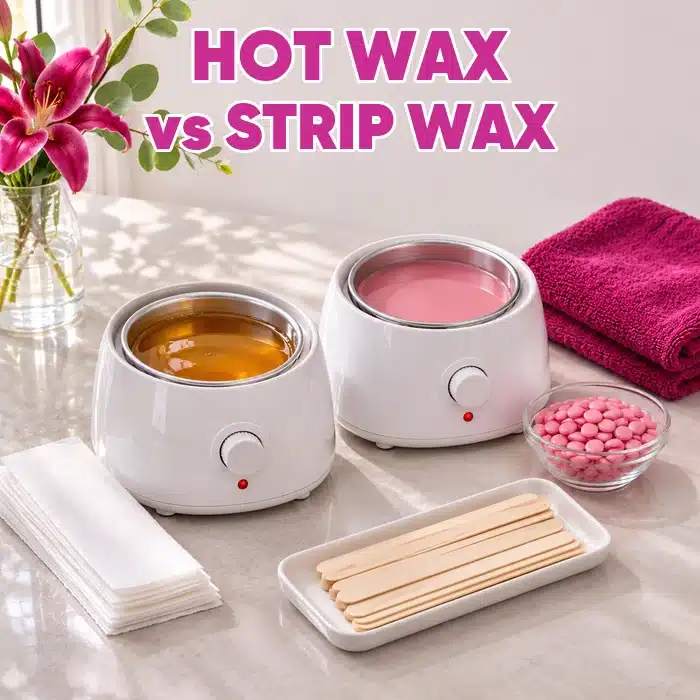
Hot wax vs strip wax is mainly a choice between two removal systems. Strip wax is spread thinly and removed with a fabric or paper strip; hot wax sets into a flexible layer that is removed without one. Strip wax is commonly chosen for larger areas, while hot wax is often used for smaller areas and coarser hair. The right choice still depends on the product, the client’s skin and hair, and your training.
If you are new to waxing, start by understanding what each system asks you to learn. Neither a pot labelled “sensitive” nor a particular wax colour replaces consultation, temperature checks or careful technique.
Hot wax vs strip wax: the differences at a glance
| What to compare | Strip wax | Hot wax |
|---|---|---|
| Other names | Warm wax or soft wax | Hard wax or non-strip wax |
| Removal | A separate strip lifts the wax and hair | The set wax itself is lifted away |
| Common starting uses | Larger areas such as legs and arms | Smaller areas such as underarms, depending on the formula |
| Practice focus | A controlled, thin application and effective strip removal | The product’s working consistency, application thickness and setting stage |
Both systems involve heated products. “Warm” and “hot” are not instructions for a universal heater setting. Use the manufacturer’s directions for the exact wax and heater you have.
How the two waxes work
Strip wax: a thin layer and a separate strip
Strip wax remains tacky rather than setting into a removable piece. For example, Salon System’s gel-creme strip wax instructions specify a thin application and removal with a strip. This makes layer control a useful focus when learning: using more product is not automatically a better application.
Hot wax: a setting layer without a strip
Hot wax surrounds the hair and sets before removal. Its behaviour varies between formulations. Some modern products are applied more thinly than the thick patches beginners may expect. Salon System’s hot-wax directions, for instance, describe a thin-to-medium layer and a particular application method. Follow your own system rather than borrowing a technique from an unrelated video.
You may hear that hot wax “grips hair, not skin”. Treat that as a simplified description, not a promise of painless waxing or protection from skin damage. Correct preparation and removal still matter.
Which areas suit which wax?
For a beginner planning a treatment menu, legs and arms are a useful starting point for understanding why strip wax is commonly used across larger areas. Hot wax is often selected for underarms and other smaller areas where hair can be coarser.
These are common uses, not fixed boundaries. Some strip-wax formulas are designed for sensitive skin, and some hot waxes are marketed for both face and body. Read the permitted uses and assess the individual rather than deciding from the body area alone.
Intimate waxing also needs the appropriate treatment training and insurance. Learning a wax type does not, by itself, establish competence in every intimate service. If your intended menu includes those treatments, check the precise syllabus before enrolling.
Skin preparation, patch tests and hygiene
The UK occupational standard for face and body waxing puts consultation, suitability tests, informed consent and working within your competence at the centre of treatment planning.
- Ask before choosing the wax. Discuss previous reactions, current medicines, skincare products and recent treatments. Examine the intended area and follow your training on reasons to postpone, adapt or refer.
- Check skin sensitivity and temperature separately. Follow the wax manufacturer’s patch-test instructions and your insurer’s conditions. A thermal check immediately before use answers a different question from an earlier sensitivity test; one does not replace the other.
- Keep the working area clean. Follow your infection-control procedure, keep clean supplies separate from used items and use a fresh disposable spatula after skin contact rather than returning it to the pot.
Medication is a reason to ask more questions, not make a diagnosis. For example, NHS advice for people taking isotretinoin warns against waxing because the skin is easier to damage. Do not tell a client to stop prescribed treatment; defer waxing and seek appropriate guidance.
Make aftercare specific
Explain the aftercare for the actual treatment and products used, including any restrictions, their duration and what to do about an unexpected reaction. Give written advice as well as discussing it. Avoid copying a generic timetable from social media when your training or product guidance says something different.
Common beginner mistakes worth noticing
Changing too many things at once. If an application does not behave as expected, pause and review the relevant demonstration and product instructions. Keep a note of the exact wax, preparation and stage that caused difficulty so your tutor can understand the question.
Judging readiness by speed. A fast demonstration can hide the decisions behind it. Focus your practice notes on what you understood and what needs feedback before making shorter appointments your goal.
Buying equipment before checking the course. Match products and tools to the treatment you will actually study. A wax heater and a bag of beads do not tell you whether a course covers strip wax, hot wax or both.
Questions new waxing therapists ask
Which wax is easier to learn?
There is no single answer for every learner. Strip wax and hot wax have different handling skills. Choose a clear first treatment goal and allow time for repeated practice. If you are fitting training around a job, our guide to planning an online beauty course around work explains how to protect time for practical sessions.
Can I practise waxing at home?
Home study is possible, but it still requires the right training stage, a suitable working space and the course’s practical and safety requirements. Professional-use products are not a shortcut to self-teaching from a blog. Before offering paid treatments, arrange appropriate insurance for the services and working arrangements you intend to provide.
Does the NSB Waxing Course cover both types?
Our Waxing Course teaches strip waxing. Its treatment module covers the client and preparation, equipment and products, and the waxing procedure. The separate Hot Waxing Course covers preparation, equipment, the hot-wax procedure and aftercare.
Both accept complete beginners. You study online with theory, practical demonstrations and tutor-assessed case studies. Materials remain available for life, there is no completion deadline, and practical resubmissions are included. Kits are optional extras; you may use suitable professional products of your own.
Start with the course that matches the wax system you want to learn. Email [email protected] with the treatments you hope to offer if you would like help choosing.
