

Health and safety for nail technicians in the UK starts with assessing your treatments, controlling product exposure and following a reliable hygiene routine, even when you work from home. A tidy room is a useful start, but you also need suitable ventilation, safe equipment and clear records. Here is how to turn those responsibilities into practical habits for a home nail or beauty business.
Starting your nail training? Our beginner-friendly package brings together five nail courses, including hygiene and safe working practices. See the Complete Nail Technician Course →
What does health and safety for nail technicians in the UK involve?
Think about everyone your work could affect: you, clients, anyone helping you and people sharing your home. HSE explains that self-employed work that poses a risk to others remains subject to health and safety law. Working alone does not automatically exempt a home salon.
In Great Britain, the Health and Safety at Work etc. Act provides the broad framework. COSHH concerns exposure to hazardous substances, including treatment products, cleaning chemicals and nail dust. RIDDOR deals with reporting specified work-related injuries, diseases and dangerous occurrences; HSE explains who must report. It does not mean reporting every minor mishap.
Northern Ireland has its own legislation and reporting arrangements. The Northern Ireland overview from Ards and North Down Council explains the separate framework.
Local licensing also varies. For example, Bexley’s special-treatment rules include manicure and some treatments in residential premises, subject to exemptions. That is a local example, not a UK-wide nail licence. Check your own council’s requirements alongside your qualification and insurance arrangements.
How do you assess products, ventilation and storage?
Start with the task: filing an enhancement, removing polish and disinfecting tools create different exposures. List the products and obtain their current safety data sheets. These describe hazards and handling precautions, but a safety data sheet is not your COSHH assessment. You must consider how you actually use the product, who could be exposed and the controls needed.
HSE’s beauty-industry guidance identifies skin irritation, allergies and breathing problems among the risks. Avoid skin contact, minimise spills and select protective equipment for the task and product. Gloves do not replace careful handling or hand care.
HSE’s nail-bar guidance recommends local exhaust ventilation, such as a downdraught table or movable extraction hood, alongside good general ventilation. Keep the work close to the extraction point and maintain the equipment. An open window or an ordinary face covering is not a substitute for suitable exposure controls.
Close containers promptly, follow storage instructions and keep products away from heat and unauthorised access. Plan for spills and product-contaminated waste before starting. Our home nail practice-space guide helps with layout, while the acrylic fumes guide explores exposure in more detail.
What is the difference between cleaning, disinfection and sterilisation?
These terms describe different processes. The definitions in Redbridge Council’s nail-treatment guidance help explain the distinction; its licensing conditions apply locally.
| Process | What it does |
|---|---|
| Cleaning | Removes dirt and residues. It comes before disinfection or sterilisation. |
| Disinfection | Reduces harmful microorganisms; it does not necessarily destroy bacterial spores. |
| Sterilisation | Renders equipment free from viable microorganisms, including bacterial spores. |
For reusable tools, follow the tool and disinfectant manufacturers’ instructions, including compatibility, dilution and contact time. A quick wipe is not automatically enough. Choose the appropriate process for the treatment and any applicable local conditions; do not describe disinfected tools as sterile.
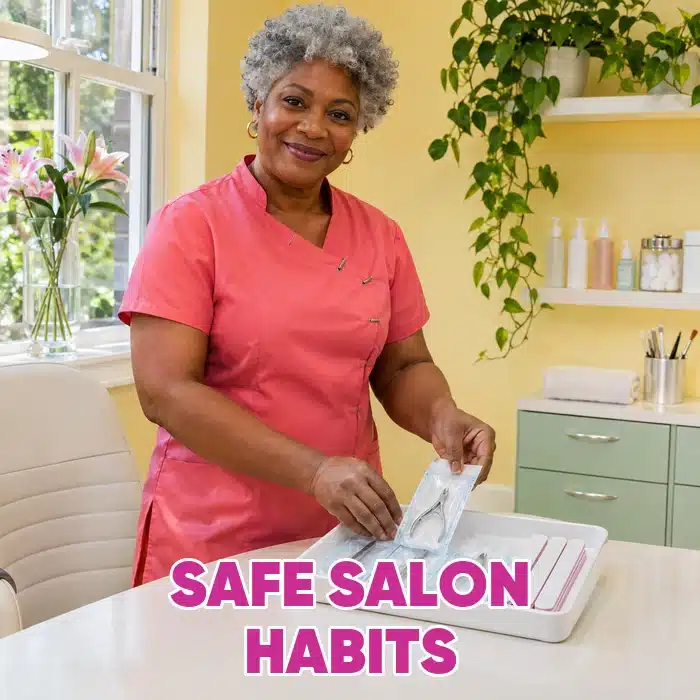
Build a reset into every appointment. Wash and dry your hands, clean and disinfect the workstation, replace used linen or couch roll, and separate used tools from clean supplies. Dispose of single-use items after use. Darlington Council’s nail-bar guidance provides a useful hygiene checklist.

Victoria’s tip
Give clean supplies and used tools separate places before you start. Add the full cleaning and product contact time to your appointment plan, so resetting your station never becomes a rushed extra.
Victoria Arpels, founder of Next Step Beauty
What should your risk assessment and client records contain?
Use HSE’s risk-assessment steps: identify hazards, consider who could be harmed, introduce controls and review whether they work. Employers with five or more employees must record significant findings. A short written record is useful for a sole trader too.
For example, a lamp cable crossing the client’s route creates a trip risk. Reroute it, check the walkway before appointments and record any further action needed. For chemical exposure, record the product, task, control measures and equipment checks. Revisit the assessment when products, treatments or your room change, or after an incident.
Consultation notes should capture relevant treatment information, checks, products used, reactions and aftercare. Follow your training and product instructions, including any required sensitivity tests. Stop if you cannot establish that a treatment is suitable.
Keep records secure and collect only what you need. Health information has extra protections: the ICO explains the lawful basis and additional condition needed. Consent to a treatment does not settle every data-protection obligation.
How the Next Step Beauty Complete Nail Technician Course works
The package covers manicure, gel polish, gel extensions, acrylic extensions and Builder in a Bottle. Its foundation learning includes hygiene and health and safety, helping you connect preparation with the treatments you practise. Compare the full nail course range if you want one specific treatment instead.
Each course in the Complete Nail Technician package is studied online at your own pace, with lifetime access to the course materials. You submit case studies of your practical work for a tutor to mark, and you get written feedback with as many resubmissions as you need. The courses are accredited by ABT, IPHM and IGCT and recognised by insurers including Towergate, Radius, Insync, Balens, Salon Gold, Westminster, SJL and PolicyBee. Business training is included, and you can join the private student group for support while you learn.
“I’ve done 4 courses with next step beauty and they were all detailed and packed with knowledge.”
Carly, review on Trustpilot
Build good habits from your first lesson.
Complete beginners are welcome, and kits are optional.
View the Complete Nail Technician Course
Payment options include Klarna, PayPal and Clearpay, subject to eligibility and provider terms.
Questions about home salon health and safety
Do I need a COSHH assessment at home?
Working from home does not remove the need to assess hazardous substances used in your business. Consider your actual products, processes and exposure, rather than treating a folder of safety data sheets as the completed assessment.
How do I sterilise metal nail tools?
Use a suitable validated process, such as steam sterilisation in an appropriate autoclave, with the required training, cleaning and maintenance. Check tool compatibility and local requirements. An ordinary UV storage box does not sterilise tools; Bexley’s guidance explains why. Do not improvise a sterilisation method.
Can I use the same routine for nails, waxing and facials?
The principles carry across, but products, equipment and client checks differ. Build a routine for each treatment from its training and manufacturers’ instructions, then update your assessment when you add a service.
Take your next step with good habits in place
Explore the Complete Nail Technician Course to build your practical foundation. If you need help choosing training for the services you want to offer, contact us.
